
Be Careful What You Wish For: Québec vs. Ottawa in the Great Temp Worker Tiff,
Québec wanted fewer temporary foreign workers, until Ottawa gave it exactly that. “Be Careful What You Wish For: Québec vs. Ottawa in the Great Temp Worker Tiff” is a 9,000-word deep dive into one of 2025’s most ironic political dramas. For years, Québec’s government demanded that Ottawa curb the growing number of temporary immigrants, warning that the influx was straining housing, services, and the French language. Then Ottawa listened, and slammed the brakes. A new federal rule capping low-wage temporary foreign workers at just 10% of a company’s workforce hit Québec harder than anywhere else, leaving farms short of pickers, hotels short of housekeepers, and restaurants struggling to keep their kitchens open. The province that had lobbied for fewer foreign workers suddenly found itself begging to keep them. Minister Jean-François Roberge, who had pressed for the clampdown, publicly called Ottawa’s response “very clumsy” and “too tough,” triggering a political facepalm that quickly went national. This feature unpacks how a well-intentioned demand became a self-inflicted economic shock, tracing the irony from government offices in Québec City to strawberry fields in Montérégie and cafés in Old Montréal. With a tone that’s both critical and cheeky, it explores how two governments talking about “control” ended up exposing the limits of it, and how real people, workers, employers, and entire communities, were caught in the crossfire. If you like sharp analysis, real-world examples, and a dash of humour in your policy reading, this is the one to click: the story of Québec and Ottawa both getting exactly what they asked for, and discovering that wishes, once granted, don’t come with refunds.
M.B.
12/1/202534 min read
We wanted fewer – but not that few
If ever there was a political drama worthy of popcorn, it’s the ongoing duel between Québec and Ottawa over temporary foreign workers. Imagine two governments insisting they agree in principle – fewer low-wage migrants, more control, a “responsible balance” – only for one to slam the brakes so hard that the other nearly flies through the windshield. That’s the kind of policy whiplash currently unfolding across la belle province.
For several years Québec politicians, particularly under Premier François Legault, warned that the province was “losing control” of immigration. The concern wasn’t only cultural or linguistic – though the defence of French is never far from any conversation in Québec politics – but practical: housing shortages, daycare backlogs, and a sense that federal gatekeeping over temporary admissions had opened wider than the province could handle.
In 2023, according to provincial labour ministry data, Québec hosted roughly 167,000 people on temporary work permits, up from just over 40,000 in 2015. Add in international students and asylum seekers, and the number of non-permanent residents exceeded 560,000, roughly seven per cent of the province’s population. That growth outpaced permanent immigration several times over. What had once been a modest stream of seasonal farmhands and hotel staff became a major demographic wave.
At first, this suited everyone. Employers filled gaps that local hiring couldn’t address. Restaurants in the Eastern Townships and packaging plants in the Mauricie finally found stable hands. Politicians could boast that Québec’s economy was humming. But by 2022 the tone shifted. The CAQ government started linking every social frustration – unaffordable apartments, crowded metro cars, ER wait times – to what it called “uncontrolled temporary immigration.”
That narrative resonated. The Institut du Québec, a respected think tank, released a report warning that temporary immigration had “grown too quickly for the system’s capacity.” It pointed to mismatches between where newcomers settled and where labour was actually needed: half stayed in Greater Montréal, even as rural employers begged for staff. Integration programs strained. French classes filled up. The government, ever anxious about the linguistic balance, saw a creeping threat to francisation.
So Québec demanded action. Minister Jean-François Roberge – newly in charge of the immigration file after a shuffle meant to project toughness – became the province’s loudest voice in Ottawa’s ear. In press conferences throughout 2024 he railed against the “open bar” of temporary visas. He accused federal bureaucrats of rubber-stamping employer requests and letting private colleges exploit the international student program. His ministry even froze new Labour Market Impact Assessments (LMIAs) for several weeks that summer – effectively stopping employers from recruiting abroad until a review could be completed.
By autumn, Roberge went further. He urged Ottawa to halve the number of temporary foreign workers nationwide – from roughly 400,000 to 200,000 – before Québec would agree to raise its permanent immigration thresholds. “It’s not about being closed,” he said at the time, “it’s about being responsible.”
In hindsight, the remark aged like milk. Because responsibility, as it turned out, was in the eye of the beholder.
The Federal Build-Up
The federal government had its own pressures. Across Canada, the number of temporary residents had ballooned to over 2.5 million by mid-2024 – a startling 6 per cent of the population. Housing advocates blamed the influx for straining rental markets. Business lobbies denied it, but the political optics were clear: Canadians felt squeezed.
Prime Minister Justin Trudeau’s cabinet, facing declining poll numbers, needed to show it was “getting serious.” The Employment and Social Development Canada (ESDC) department began drafting restrictions to curb reliance on low-wage TFWs. Officials cited internal audits showing that many employers renewed the same positions year after year rather than upskilling or raising pay. To them, the program had drifted from a “last resort” to a convenient pipeline.
Then came Québec’s repeated calls for cuts. From Ottawa’s standpoint, the province was practically begging for federal intervention. So in early October 2024, ESDC unveiled what it called a “targeted re-balancing.” Journalists quickly gave it another name: the 10 per cent rule.
The 10 Per Cent Shock
The policy looked straightforward on paper:
No more than 10 per cent of any company’s workforce could consist of low-wage temporary foreign workers.
In regions where unemployment exceeded 6 per cent, no new LMIAs for low-wage jobs would be approved.
Existing work permits could still run their course, but renewals would be scrutinised.
The validity period for LMIAs was halved from twelve months to six.
Ottawa framed this as an across-Canada measure to “restore balance.” But in practice, its impact varied dramatically. Alberta’s energy firms barely noticed. Ontario’s sprawling urban economy adjusted. Québec, however, reeled.
Why? Because Québec’s demographic reality is unique. Rural depopulation, early retirements, and a shrinking youth cohort have made its regions acutely dependent on imported labour. In towns like Saint-Georges or Rivière-du-Loup, entire food-processing lines operate thanks to Guatemalan and Filipino crews. In tourist enclaves like Charlevoix, housekeeping staffs are composed half of newcomers on short-term visas. A 10 per cent ceiling meant that many of these businesses were now technically non-compliant overnight.
Within weeks, alarm bells rang. Employers warned they would have to let trained workers go simply to meet the new ratio. The Québec Hotel Association predicted service reductions during ski season. The Association Restauration Québec cautioned that restaurants might close Mondays through Thursdays just to cope.
Ottawa’s officials defended the move. “Canadians must always be first in line for jobs,” an ESDC spokesperson said. They cited data showing that TFW applications had dropped 50 per cent nationwide since the announcement – exactly the outcome the government desired.
But in Québec City, satisfaction turned to exasperation. Minister Roberge called a press conference and declared the measure “très maladroite – very clumsy.” “We never told Ottawa to be so severe,” he insisted, particularly “not in our regions.” Translation: we wanted moderation, not mayhem.
The Facepalm Heard Across the Province
The contradiction was obvious. For months, the CAQ government had complained that temporary immigration was out of control. Now it complained that Ottawa’s control was too tight. The memes practically wrote themselves: Ottawa as an over-eager waiter who, asked to “top off the glass,” instead dumps the bottle.
Still, beyond the irony lay real economic pain. Québec’s unemployment rate outside Montréal hovered around 4 per cent in late 2024 – functionally full employment. Local job-seekers simply didn’t exist in sufficient numbers to replace departing TFWs. And in some trades, the language requirement (French fluency) narrowed the domestic pool even further.
Businesses began lobbying the province to negotiate exemptions. “We’re not asking for more, just to keep the ones we already have,” said Martin Vézina of the restaurant association. The line became a refrain across sectors.
By early 2025, the problem had a human face. Foreign workers who had built lives in small towns found themselves uncertain whether they could renew. Some had children enrolled in local schools, mortgages co-signed by employers, or fledgling permanent-residency applications in process. Suddenly, their status depended on an arithmetic ratio.
Employers were distraught. A strawberry processor in Lanaudière told reporters he risked losing half his night shift. “We spent years training these people,” he said. “Now we might have to send them home because of a percentage.”
Even pro-CAQ municipal leaders broke ranks. In Rimouski, the mayor publicly pleaded for “more flexibility.” The irony was not lost: rural Québec, which had cheered promises to protect “our way of life,” was now begging to keep its Filipino and Mexican neighbours.
Historical Echoes: Québec’s Perpetual Balancing Act
To understand why this contradiction runs so deep, you have to see Québec’s immigration philosophy over the decades. Since the 1960s Quiet Revolution, the province has viewed migration through a dual lens: economic necessity and cultural preservation. It welcomes newcomers, but on its own terms. The 1991 Canada–Québec Accord granted the province unique powers to select most of its permanent immigrants and to design its own integration programs. But temporary workers fall largely under federal jurisdiction.
That asymmetry has long irritated Québec. When things go smoothly, Ottawa gets credit for facilitating labour flows. When they don’t, Québec absorbs the political fallout. Hence Roberge’s frustration: he wanted leverage, not a federal bulldozer.
There’s also a rhetorical pattern: governments in Québec often talk tough on immigration during calm times and loosen up during labour crunches. In the mid-2000s, for example, then-Premier Jean Charest pleaded for more TFWs to save asparagus harvests. A decade later, the Liberals under Philippe Couillard lamented that dependence. The pendulum never stops swinging.
The Early 2025 Reality Check
By spring 2025, the data told the story.
TFW applications in Québec had dropped nearly 60 per cent compared with the previous year.
Manufacturing job vacancies climbed to 11 000, the highest in a decade.
Tourism regions reported occupancy losses of 10-15 per cent due to reduced service capacity.
Economists warned of a self-inflicted slowdown. The Desjardins Group estimated that even a 1 per cent reduction in the available workforce could shave 0.3 points off Québec’s GDP. That sounds small until you translate it into tens of thousands of unfilled positions.
The CAQ government scrambled. Roberge wrote to Ottawa requesting a “grandfather clause” allowing all existing TFWs outside Montréal and Laval to stay, even if companies exceeded 10 per cent. He also proposed sector-specific caps – 20 per cent for hospitality, 30 per cent for agriculture-adjacent processing – similar to the pre-2024 framework.
Ottawa listened politely but stood firm. “We are focused on ensuring Canadians and permanent residents have first access to jobs,” its statement read. Translation: not a chance, at least for now.
Where the Blame Lands
For Québec voters watching from the sidelines, it’s hard to know whom to blame. Ottawa acted on Québec’s own complaints, yet delivered the fix with bureaucratic bluntness. Québec’s ministers, in turn, seemed to forget how forcefully they had demanded that very intervention.
Political analysts see it as a cautionary episode in intergovernmental theatre. “Each level of government plays to its gallery,” wrote political scientist Geneviève Tellier. “Québec accuses Ottawa of negligence; Ottawa responds decisively; Québec then denounces the decisiveness.” The cycle continues because both sides benefit symbolically: Québec asserts autonomy, Ottawa asserts leadership. The economic actors caught in the middle – employers and workers – become collateral.
Human Stories Amid Policy Acronyms
Behind every acronym – TFW, LMIA, CAQ – there’s a person. Take Ramon, a welder from the Philippines who’s spent five years in Drummondville. His employer sponsored repeated renewals while he awaited permanent residency. In 2025 he learned that because the factory’s foreign-worker share slightly exceeded 10 per cent, his next LMIA application might be denied. “I’ve been here long enough to call this home,” he said. “But now they say maybe no.”
Or Lucie, the owner of a 40-seat bistro in Saguenay. Three of her six kitchen employees are from abroad. “They speak French, they live here year-round, they pay taxes,” she said. “If I lose them, I close lunch service.” The irony isn’t lost on her either: “The same government that told me to hire locally is the one that keeps telling young people to move to Montréal for better jobs.”
These stories multiplied in local papers through 2025. Each illustrates the central paradox: Québec’s economic model increasingly depends on the very workers its political discourse treats as temporary guests.
Ottawa’s Move and Why It Hit Québec Hard
The Federal Logic: Fixing a National Problem with a National Tool
When Ottawa designed the 10 % rule, it believed it was crafting a fair, uniform instrument.
The reasoning went like this: if temporary foreign workers are meant to be a “last resort,” a national ceiling would guarantee proportional restraint. A 10 % share was, in bureaucratic logic, neat and symmetrical. Every employer could still hire a handful of outsiders, but no company could run primarily on imported labour.
The rule also dovetailed with another federal objective: easing pressure on Canada’s overheated rental market.
The Department of Finance had been warning that population growth was outrunning housing construction by hundreds of thousands of units a year. Temporary residents—students and workers—accounted for much of that increase. Tightening the TFW tap looked like an indirect but immediate way to calm housing demand without politically dangerous rent controls.
To cabinet strategists, this was good politics: a two-for-one solution. It pleased voters who thought immigration was “too fast,” and it gave the appearance of fiscal discipline in an election-sensitive year.
Québec’s ministers, who had been vocal about the same issues, seemed like natural allies.
Yet what looks tidy on a federal spreadsheet can look catastrophic on a provincial one.
Québec’s Structural Weakness: Where the Rule Bites
Economists have long noted that Québec’s labour market behaves differently from the rest of Canada.
Demographically older, geographically dispersed, and more linguistically homogeneous, it has three particular traits that made Ottawa’s national fix uniquely painful.
Regional Demography:
Outside Montréal, entire administrative regions are shrinking. The Gaspé Peninsula has lost nearly 15 % of its working-age population since 2001. The Côte-Nord and Abitibi regions are ageing twice as fast as the Canadian average. These are precisely the places that depend on low-wage seasonal labour—from berry pickers to fish-plant packers. Local unemployment might register at 6 % on paper, but that includes retirees and part-timers; the actual supply of able-bodied recruits is tiny.Skill and Language Constraints:
In Ontario or Alberta, a factory can quickly advertise nationwide in English. In rural Québec, every posting requires functional French. That shrinks the domestic candidate pool dramatically.
When Ottawa said, “hire Canadians first,” Québec employers quietly replied, “we’ve been trying for years.”Economic Composition:
Roughly 29 % of Québec’s GDP still comes from manufacturing and resource processing—double the share in British Columbia. These sectors rely on repetitive, lower-wage roles that Canadians increasingly shun. The 10 % cap therefore landed exactly where Québec’s economy is most vulnerable.
Add those factors together, and the uniform federal limit became, in practice, a Québec-specific constraint:
Québec ≈ 13 %; Ontario ≈ 8 %; Alberta ≈ 6 %; Atlantic ≈ 9 %.
Immediate Fallout: The Arithmetic of Shortage
Consider a mid-sized hotel in the Laurentians employing 100 people.
Before October 2024, up to 30 of them could legally be low-wage temporary workers under the “hospitality exemption.” The new rule allowed only 10. Twenty seasoned housekeepers, dishwashers, and line cooks suddenly fell outside compliance. Renewal applications were rejected; work permits expired without replacement.
Multiply that arithmetic by thousands of businesses and the picture becomes clear: the cap effectively removed one in five workers from some regional labour forces.
The hospitality association estimated that Québec’s tourism sector alone risked losing 12 000 to 15 000 staff by summer 2025.
Manufacturers projected a similar number. Restaurants, already thinly staffed, began consolidating shifts. “There’s a domino effect,” said one Laval restaurateur. “If we shorten hours, suppliers lose business, delivery drivers get fewer routes, local farms sell less produce.”
In rural towns, where one factory or resort anchors the tax base, those dominos reach the municipal budget. Fewer shifts mean fewer payroll deductions, fewer family purchases, and eventually fewer property taxes collected. For mayors, the TFW policy wasn’t an abstract debate about sovereignty; it was a spreadsheet of lost revenue.
Ottawa’s Defence: ‘Transition, Not Dependence’
Federal officials insisted the pain was temporary—pun unintended.
They argued that employers had become addicted to quick foreign recruitment instead of investing in automation or training. “Every sector says it can’t function without the program,” one senior civil servant told La Presse. “That’s precisely the problem.”
Ottawa released guidelines encouraging companies to apply for “productivity transition grants” if they could prove the cap hurt production. The grants, small and paperwork-heavy, did little to calm nerves. To Québec businesses juggling French paperwork and federal forms, it felt like double punishment: first lose workers, then drown in forms to get a pittance of relief.
The government also reminded provinces that immigration is a shared jurisdiction. “We consult extensively,” ESDC said in its statement, “but national programs must serve national interests.”
Translation: Québec may grumble, but the Constitution sides with Ottawa.
Québec’s Counter-Argument: Context Matters
Roberge countered that the federal calculus ignored Québec’s specific mission to protect its language and culture. Because every new permanent immigrant requires integration in French, the province deliberately keeps permanent admissions moderate, around 50 000 per year. Temporary workers, however, had become a safety valve to meet economic needs without altering that linguistic balance.
By slamming that valve shut, Ottawa forced a dilemma: either raise permanent immigration (politically explosive) or accept regional decline (economically suicidal). “The federal government is acting as if Québec were Ontario,” Roberge complained, “but our realities are completely different.”
The CAQ government also took issue with Ottawa’s definition of low-wage. Under federal tables, any job paying below the provincial median counts as low-wage; in Québec that median is lower than elsewhere. A position paying $23 per hour in Saguenay, decent by local standards, still triggers the restrictive stream, while in Vancouver it would not. The rule thus penalised Québec employers twice: once for language, again for lower pay scales.
Business Reaction: Panic Meets Pragmatism
By early 2025, the lobbying machine roared.
The Manufacturers and Exporters Association warned of a “catastrophic fall” in output by autumn.
The Hotel Association pleaded for immediate exemptions in tourist regions.
The Restaurant Association (ARQ) began collecting signatures for a special Quebec-Ottawa working group to restore the previous 20–30 % cap in hospitality.
One hotelier summed up the frustration neatly: “Québec tells us to hire francophones, Ottawa tells us to hire Canadians, but neither provides people who actually apply.”
Some businesses sought creative detours. A few converted low-wage positions into “mid-wage” ones on paper by slightly increasing salaries, thus escaping the cap. Others reclassified roles as seasonal contracts tied to agriculture, a stream still exempt. Consultants in Montréal joked that LMIA paperwork had become the province’s newest cottage industry.
Human Capital in Limbo
Amid the policy chess, thousands of workers faced uncertainty.
The majority were from Latin America or Southeast Asia—communities that had put down roots over several years. Because Québec allows TFWs to access French-language schooling for their children, many families had integrated deeply. When renewals froze, landlords hesitated to extend leases; banks questioned loan applications.
Community groups reported spikes in anxiety. “People call us crying,” said the director of a migrant-support NGO in Trois-Rivières. “They did everything right—paid taxes, learned French, renewed legally—and now they’re told they might have to leave.”
For many, the logical next step would be to apply for permanent residence, but that path runs through federal quotas as well. Ironically, the workers most linguistically and economically integrated were the ones being filtered out first because their employers had exceeded 10 %.
Regional Mayors Push Back
By March 2025, a rare alliance had formed: chambers of commerce, labour unions, and municipal leaders jointly petitioned both governments.
Their message was blunt: this is hurting real communities.
In Drummondville, the mayor argued that temporary workers had revived vacant housing stock. “Without them, our elementary schools would close classrooms,” he said. In Sherbrooke, the regional council calculated that each TFW supported roughly 0.7 indirect local jobs—from grocers to bus drivers. “Cut one, you cut almost two,” its report warned.
Québec City tried to channel that anger without contradicting its earlier rhetoric. Roberge launched a communications campaign distinguishing ‘temporary volume control’ (good) from ‘federal rigidity’ (bad). The nuance convinced few. Editorial cartoons in Le Devoir depicted him holding a “Slow Down” sign as an Ottawa truck labelled “10 % CAP” flattened his own policies.
Ottawa Holds Its Line—Publicly
Despite the backlash, Ottawa’s ministers projected calm. Internally, however, civil servants acknowledged the disproportionate effect on Québec. Leaked memos revealed discussions of a “Québec adjustment window” for sectors demonstrating genuine shortages. But officials worried that softening the rule for one province would trigger demands from others. Alberta, for instance, had already requested exceptions for meat-packing plants. A federal compromise for Québec might unravel the uniformity of the policy nationwide.
Thus, Ottawa opted for small technical tweaks rather than a public reversal. It allowed employers to average their 10 % ratio over several sites instead of per location and quietly accelerated processing for renewals filed before the cut-off. These gestures bought time but not goodwill.
Political Theatre: Federalism on Full Display
The temp-worker fight quickly became a stage for broader grievances.
Québec nationalists framed it as proof that the province remains “subordinate” within Confederation. Opposition leader Paul St-Pierre Plamondon accused Legault of “outsourcing our sovereignty to Ottawa.” Federal Liberals shot back that Québec had explicitly requested stricter controls. The Conservatives blamed both, promising to replace the cap with “common-sense regional targets.”
Televised debates turned surreal: politicians agreeing that there were “too many” temporary workers while simultaneously demanding exemptions for their ridings. The average viewer could be forgiven for wondering what, exactly, anyone wanted.
Media Narratives: Irony as Headline
Québec’s press feasted on the contradiction. La Presse ran a column titled “When Ottawa Listens Too Well.” Le Journal de Montréal called it “a slap served cold.” English-language outlets across Canada, meanwhile, highlighted the humour: “Be Careful What You Wish For,” quipped CityNews Montréal, coining the phrase that inspired this very article.
Editorial boards differed on substance but agreed on optics: Québec had asked for a slowdown and got one; complaining now looked hypocritical. Yet, public sympathy largely favoured the small businesses bearing the cost. Polls showed 62 % of Quebecers considered the federal policy “too abrupt,” even among those who supported reducing overall immigration.
The nuance mattered. Most citizens weren’t opposed to welcoming fewer newcomers in theory—they just didn’t want their favourite bakery or motel to close because of a spreadsheet in Ottawa.
Behind Closed Doors: Numbers Tell the Tale
By mid-2025, the statistics department in Québec’s labour ministry published its own audit:
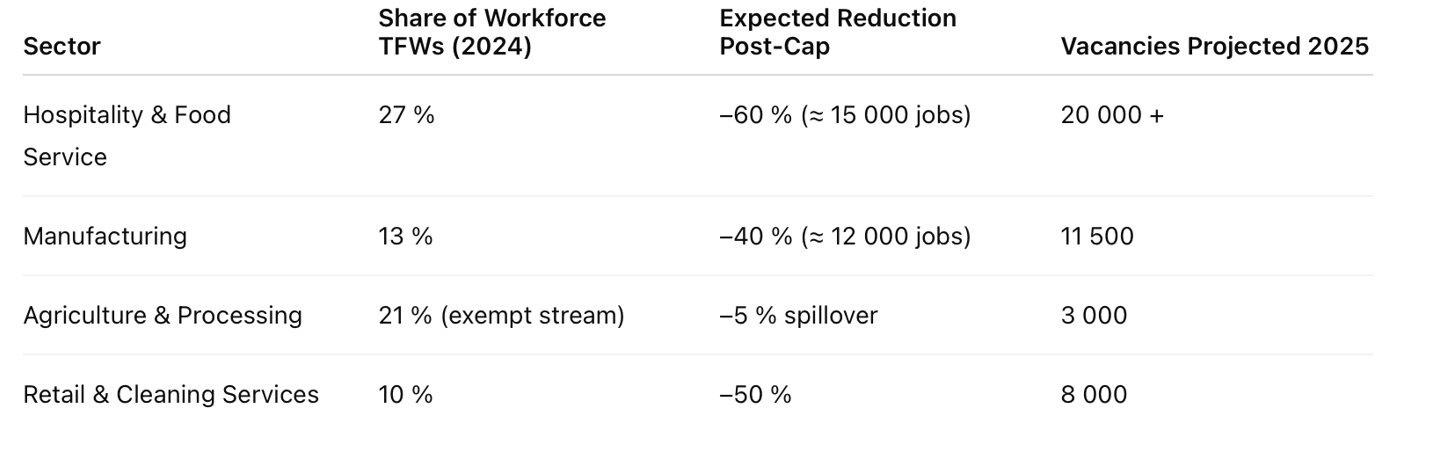
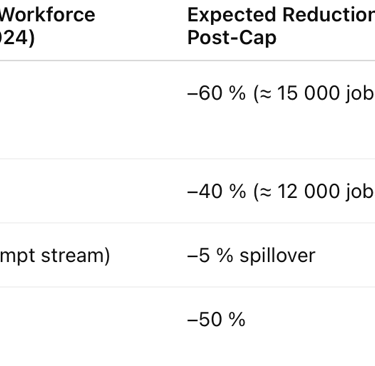
Even accounting for automation and domestic hiring, the province faced a net shortfall of roughly 40 000 workers. Economists likened it to removing the entire population of Victoriaville from the labour pool overnight.
Long-Term Implications: Productivity and Reputation
Beyond immediate shortages, Québec businesses feared losing international credibility. For years they had cultivated reputations as stable employers under the TFW program, ensuring return visits from trusted crews each season. Sudden cancellations risked severing those relationships. Recruiters in Honduras and Morocco redirected candidates to Ontario or Manitoba, perceiving Québec as unpredictable.
Meanwhile, potential permanent immigrants, nurses, engineers, technicians, watched the turmoil and hesitated. “If the government can change the rules this fast for workers, what about us?” asked one applicant interviewed by Radio-Canada. Immigration lawyers warned that Québec’s brand as a destination of stability was eroding just when it most needed talent.
Economic Ripples and Consumer Effects
By summer, consumers began noticing subtler effects: longer check-in lines, reduced menus, delayed manufacturing orders. Prices in some tourist regions crept up as businesses passed on labour scarcity costs. Economists at Université Laval estimated that the TFW restrictions alone added 0.1 percentage points to Québec’s inflation rate for 2025.
Politically, that figure mattered. The Legault government prided itself on cost-of-living relief; now its own earlier rhetoric was indirectly raising grocery bills.
Ottawa’s Quiet Reassessment
Sometime around July 2025, Ottawa’s internal tone softened. ESDC began informal talks with Québec’s ministry about introducing a “regional flexibility clause.” Under the proposal, regions with documented vacancy rates above 5 % could apply for a temporary cap of 20 % instead of 10. The discussions leaked, and suddenly national newspapers framed it as a “Québec carve-out.” Western premiers protested that such asymmetry would break fairness.
Caught again between principle and pragmatism, Ottawa stalled. It promised a full review by early 2026 but refused to budge immediately. By then, harvest season and summer tourism were already underway, too late for many employers.
Cultural Undercurrents
While economists debated ratios, cultural commentators saw deeper symbolism. The quarrel, they argued, exposed Québec’s ambivalence toward globalisation. On one hand, the province prides itself on openness—its festivals, cuisine, cosmopolitan Montréal flair. On the other, its political DNA still prioritises preservation over expansion. Temporary foreign workers embody that tension: they are welcomed for their labour but not always for their permanence.
This ambivalence colours public discourse. A radio host in Québec City captured it perfectly: “We want help in our kitchens, but not at our dinner table.” The TFW cap forced that contradiction into daylight.
Academic Perspectives
Sociologists at Université de Montréal published a paper calling the conflict “a clash between demographic reality and political imagination.” They noted that Québec’s fertility rate—1.38 children per woman—is among the lowest in North America. Without sustained immigration, the working-age population will shrink by nearly half a million within fifteen years. “To demand fewer temporary workers without raising permanent immigration is to wish for an arithmetic miracle,” the authors wrote. “Ottawa simply removed the illusion.”
Economists were blunter. “A 10 % cap is arbitrary,” said Pierre Fortin, emeritus professor at UQAM. “But the bigger issue is Québec’s dependency on a labour model it publicly denies.” He compared it to Europe’s seasonal-worker conundrum: essential yet politically inconvenient.
Public Sentiment Evolves
As the dust settled, Québecers began distinguishing between control and restriction. Opinion surveys showed that while 58 % supported the principle of “reducing temporary immigration,” only 27 % supported the specific 10 % cap once its consequences were explained. Rural approval was even lower. In short, people liked the idea of a brake, not a wall.
By late autumn, editorial voices shifted from blame to solution. Le Soleil called for “joint governance of temporary programs,” proposing a Québec-specific advisory board with equal federal-provincial seats. The concept gained traction among moderate voters tired of jurisdictional ping-pong.
The Ironic Silver Lining
If there was a paradoxical upside, it was that the crisis forced both governments to share data transparently for the first time. Provincial and federal databases—long incompatible—were suddenly synchronised to track worker locations, contract lengths, and wages. That cooperation, though born of conflict, laid groundwork for smarter policymaking ahead.
Some observers even credited the cap for sparking overdue conversations about automation grants, training incentives, and French-language upskilling. “We were lazy,” admitted one manufacturer. “Now we have to innovate.”
Whether that innovation can fill tens of thousands of vacancies is another question.
The Fallout Across Sectors
1 – Hospitality: Empty Beds and Full Irony
Few industries felt the cap’s sting faster than hospitality. The moment Ottawa’s 10 % limit took effect, hotel managers began frantically recalculating staffing charts. A property with 120 employees could now keep only 12 low-wage foreign staff on paper. Yet in reality, many resorts in Québec’s tourist corridors ran with 25 to 35 % of their crews from abroad.
In Charlevoix, the Hôtel Le Massif quietly shuttered one restaurant wing in February 2025. “We didn’t fire anyone; we just couldn’t replace those who left,” explained its director. The same refrain echoed in Tremblant, the Magdalen Islands, and Old Québec’s cobblestoned core. Guest rooms went un-cleaned until mid-afternoon, breakfast buffets became continental, not hot.
Paradoxically, tourism demand was soaring again post-pandemic. International visitors returned in record numbers, drawn by a weak Canadian dollar. “We have customers but no staff,” sighed a front-desk manager in Québec City. “It’s like owning a restaurant during a food shortage.”
The Association Hôtellerie Québec launched a province-wide survey in spring 2025: 74 % of respondents said they would reduce service hours that summer; 41 % expected to close sections entirely. The knock-on effect extended to laundry services, shuttle drivers, and tour operators. Each missing worker rippled outward.
The irony was rich. For years, Québec politicians framed temporary foreign labour as a stopgap. In 2025, the “stopgap” proved to be the only thing keeping rooms ready and kitchens running.
2 – Restaurants: When Menus Shrink
If hotels were limping, restaurants were crawling. The ARQ estimated that one in five eateries already faced chronic vacancies before Ottawa’s reform; after it, nearly one in three did.
Céline Diallo, owner-chef of a Caribbean bistro in Old Montréal, became a reluctant spokesperson for the crisis. Two of her Guinean cooks could not renew their permits; the third, from Haiti, was still waiting for LMIA approval when Ottawa’s moratorium on high-unemployment regions froze new files. “I used to worry about my spice deliveries,” she told reporters. “Now I worry about human beings.”
Menus slimmed down as chefs reorganised kitchens around whoever remained. Fine-dining venues simplified plating; bistros cut lunch shifts. “We replaced love with logistics,” one restaurateur joked darkly.
The labour gap collided with another uniquely Québécois factor: the French-language workplace requirement. Every new hire must be able to function in French after a set period. For many temporary workers, that was never an issue—they were already learning. But when owners turned to Canadian students or retirees as replacements, language retention ironically dropped: local anglophones could skirt the rule more easily than foreign hires enrolled in francisation classes. The policy designed to protect French now risked undermining it.
By June 2025, café owners in Montréal’s Plateau district reported cutting opening hours by an average of 18 %. Provincial data showed restaurant closures up 7 % year-over-year—the first increase since the pandemic.
3 – Agriculture: The Exemption That Wasn’t
Officially, farming was spared. Primary agriculture—the seasonal program for field workers—remained outside the 10 % rule. But the boundary between “farm” and “food processing” blurred quickly.
Take the Montérégie region, where strawberry and vegetable farms rely on hundreds of Guatemalan labourers. Their outdoor picking was exempt, but the adjacent canning and packing facilities were not. Those facilities lost up to 40 % of staff overnight. “We can pick it, but we can’t pack it,” said one grower. Result: produce left spoiling in warehouses.
Transporters also struggled. Many trucking firms serving agri-co-ops classified drivers as low-wage TFWs because of piece-rate pay structures. Under the new definition, they hit the cap immediately. Delivery bottlenecks followed, pushing local supermarket prices up 3 – 5 % in late summer.
Farm owners who once championed “Québec jobs for Québecers” began lobbying for permanent residency pathways for their veteran foreign workers. “They speak French, they pay taxes, they coach soccer here,” said a federation spokesperson. “They’re more Québécois than half our cousins in Montréal.”
The Ministry of Agriculture warned quietly that if Ottawa did not soften its interpretation by the 2026 planting season, fruit exports could drop by a quarter. That forecast circulated in industry circles but was never publicly released—too politically awkward for both levels of government.
4 – Manufacturing: The Slow Grind
Manufacturing tells a different, grimmer story. Québec’s 11 000 vacant factory jobs already represented a structural weakness before the cap. When foreign renewals froze, assembly lines literally stopped.
In Drummondville, a plastics plant employing 250 people depended on 60 foreign technicians. The new ratio allowed only 25. Management offered overtime to locals; few accepted. By April 2025, two production lines sat idle. “Every machine that stops costs us 25 000 $ a day,” said the plant manager. “We wanted fewer foreign workers? Congratulations—now we have fewer shifts.”
Julie White of Québec Manufacturers & Exporters warned that entire contracts were being lost to Ontario competitors with more flexible provincial programs. “We tell clients we can’t deliver; they switch suppliers. Those orders never come back,” she said.
Her association’s spring report estimated a 1.2 billion $ hit to output in the first half of 2025—0.25 % of provincial GDP. The irony: that shortfall erased almost the same economic gain that reducing TFW housing demand supposedly saved.
Anecdotally, some plants tried automation. Robotics suppliers saw a brief surge in orders for pick-and-place arms. But integration cycles run 18 months or more; most firms simply could not adapt in time. “You can’t replace 50 people with a robot by September,” said one engineer.
5 – Retail, Cleaning, and Care: The Invisible Collapse
Retail and janitorial services rarely make headlines, yet they represent thousands of jobs often filled by newcomers. The 10 % cap decimated staffing agencies that specialised in placing temporary residents. Malls outside Montréal shortened hours; building-maintenance contracts went unfulfilled.
In long-term-care homes, which technically fall under provincial jurisdiction but depend on federally regulated permits, administrators scrambled to keep personal-support aides. Although healthcare itself was excluded, ancillary roles—kitchen staff, cleaners, laundry aides—were not. Losing them meant nurses folding sheets.
At a senior residence in Shawinigan, management asked office clerks to rotate into laundry duty. “We’re burning out our own staff,” confessed the director. Families noticed. Complaints about cleanliness tripled in one quarter, fuelling yet another media cycle about “crisis in elder care.”
6 – Economic Chain Reactions
Labour shortages rarely stay confined. When hospitality slows, suppliers slow; when manufacturing stalls, logistics follows. Economists traced a subtle ripple through 2025 Q2 statistics:
Freight volumes at the Port of Montréal down 3.7 %.
Provincial electricity consumption (a proxy for industrial activity) down 2 %.
Small-business tax remittances down 4 % year-over-year.
None of these numbers alone spelled recession, but together they painted a drag attributed largely to the labour cap.
Desjardins Economics concluded that the TFW restrictions cost roughly 20 000 full-time-equivalent jobs and 0.3 points of GDP in 2025. The figure became political ammunition: opposition leaders branded it “the Legault-Trudeau tax on labour.”
7 – Regional Case Studies
a) Charlevoix: Tourism on Life Support
This postcard region, mountains, whales, fine dining,illustrates how dependent the rural economy had become on outsiders. Out of 6 000 hospitality positions, nearly 1 800 were TFWs pre-cap. The reduction forced hotels to cancel corporate retreats and conferences, cutting winter revenue by 18 %.
Local schools noticed something unexpected: fewer children. Many TFW families had integrated long enough to enrol kids; when parents left, enrolment dropped, threatening class funding formulas. The “temporary” workforce had quietly become community infrastructure.
b) Lanaudière: Factories and Faith
Lanaudière’s small Catholic parishes had embraced Filipino and Honduran workers wholeheartedly; Sunday services filled again after decades of decline. By spring 2025, pews emptied once more as parishioners returned home. The local bishop publicly lamented the exodus, calling it “a human loss disguised as policy.” His sermon went viral.
c) Abitibi-Témiscamingue: The North’s Double Bind
Mining operations there paid well above median wages—technically exempt—but contractors who maintained camp kitchens and cleaning crews were not. A single large mine estimated that the absence of 40 support workers delayed operations six weeks, costing millions. Local First Nations, who often filled supervisory roles, complained they were being blamed for absentee crews. The issue deepened existing tensions between federal oversight and regional autonomy.
8 – Employers’ Survival Tactics
Desperation breeds creativity. Here’s what emerged across 2025:
Job-Sharing Networks: Competing restaurants in the same town began pooling staff—one worker handling breakfast shifts at Café A and dinners at Bistro B. Informal WhatsApp groups coordinated schedules.
Mini-Co-Ops: In Saguenay, four microbreweries formed a cooperative to sponsor a single LMIA for rotating duties, arguing the worker served “the regional craft-beer ecosystem.” Ottawa hadn’t anticipated that phrase.
Automation in Hospitality: Hotels installed self-check-in kiosks and robotic vacuum pilots. Guests called them “cute,” staff called them “Band-Aids.”
Housing Incentives for Locals: Municipalities offered rent rebates to Québécois youth who took regional service jobs. Uptake was minimal—city life remained more attractive.
The ingenuity was admirable, but none of these measures closed the gap entirely. The labour vacuum persisted like low-grade fever: tolerable, draining, endless.
9 – The Media Portraits: Faces, Not Numbers
By mid-year, journalists shifted from statistics to storytelling.
CityNews Montréal followed Josefa, a Guatemalan cleaner at a Saint-Sauveur motel. After seven years, her renewal was refused because her employer’s ratio exceeded 10 %. She left quietly in June, sending her Canadian-born toddler to stay with friends until paperwork cleared elsewhere. Her photo—smiling beside stacked towels—ran above the headline “Essential but Expendable.”
In Trois-Rivières, Le Nouvelliste profiled factory supervisor Patrick Pelletier, now working 70 hours a week to cover missing colleagues. “People think it’s about foreigners,” he said. “It’s about humans.”
These human stories slowly reframed the debate. What began as a technocratic dispute over percentages turned into a moral question: how temporary can a person be after five years of contribution?
10 – Québec’s Political Whiplash
Inside the National Assembly, opposition parties smelled blood.
The Parti Québécois accused Legault of “asking Ottawa to build a fence, then complaining it’s ugly.” Liberals proposed a pragmatic fix—provincial management of LMIA quotas through a bilateral accord. The CAQ rejected that idea publicly yet explored it privately.
Roberge’s own rhetoric softened. Early interviews had framed the issue as Ottawa’s overreach; by August he acknowledged Québec’s mixed messaging. “We need both control and compassion,” he said, a line that satisfied no one but earned nods for honesty.
11 – Workers’ Voices Re-enter the Conversation
A side effect of the crisis was the emergence of organised migrant advocacy.
Groups like Travailleurs Unis du Québec held peaceful marches in Montréal and Québec City. Placards read “Pas temporaires — essentiels.” The marches drew modest crowds but heavy symbolism: French slogans, Québec flags, and chants for inclusion rather than exception.
By framing themselves as defenders of French workplaces rather than intruders, these workers subtly shifted the narrative. Even conservative talk-show hosts conceded that “the problem isn’t the workers, it’s the math.”
12 – Academic and Business Conferences
When economists, demographers, and HR directors gather in the same room, sparks fly. At the June 2025 Forum sur la Main-d’œuvre in Québec City, keynote speaker Emna Braham of the Institut du Québec summarised the paradox succinctly: “We can’t both reduce temporary immigration and expect full employment. We must choose consistency or accept contradiction.”
Her slide deck showed projected labour-force declines through 2035 even under optimistic birth-rate scenarios. The crowd—mainly employers—nodded grimly. One quipped, “At this rate, robots will unionise before we train enough locals.”
Later panels explored creative policy blends: regional residency programs, fast-track language grants, and shared provincial-federal oversight. None promised miracles, but they signalled a slow move from outrage to solutions.
13 – Ottawa’s Incremental Adjustments
Facing sustained pressure, Ottawa introduced two minor amendments in September 2025:
The “Continuity Clause.” TFWs already employed for three years or more in the same job could renew once outside the cap, provided their employer submitted a transition plan toward local recruitment.
Sectoral Flexibility Pilot. Selected tourism zones (Charlevoix, Gaspésie) could apply for temporary 20 % limits until March 2026.
The announcement arrived quietly, almost sheepishly. No minister held a press conference. Yet for Québec’s employers it felt like oxygen. “Finally, recognition that we exist,” said the ARQ president. Newspapers called it “a backdoor apology.”
14 – Language and Integration: The Overlooked Victim
Lost amid spreadsheets was the linguistic angle. The 10 % cap inadvertently derailed Québec’s flagship francisation programs. Many TFWs enrolled in evening French classes funded per participant; when their numbers dropped, budgets were cut. Teachers lost jobs, classrooms closed. “We’re punishing those who were actually learning French,” said a program coordinator in Lévis.
Meanwhile, employers who had invested in bilingual training found their efforts wasted when trained staff departed. “We spent thousands on classes,” complained one hotel HR manager, “and now Ottawa tells them to leave before they can use that French.”
Irony piled upon irony: a federal policy justified partly in the name of integration was dismantling integration successes.
15 – The Broader Social Mood
By late autumn 2025, the tone across Québec turned from anger to fatigue. Ordinary citizens, initially amused by political irony, grew weary of closed restaurants and reduced services. Pollsters found frustration not with immigrants, but with governments. “Everyone blames someone else,” said one respondent. “I just want my morning coffee again.”
Talk-radio hosts, once fiery on immigration, now lamented administrative chaos. The phrase “trop de paperasse, pas assez de personnes”—too much paperwork, not enough people, became a running joke.
Economists warned that political fatigue could morph into apathy toward future reforms. “When everything feels temporary,workers, policies, promises, nothing sticks,” wrote columnist Chantal Hébert.
16 – Looking Beyond the Numbers
The human mosaic left behind was complex. Some foreign workers obtained new placements under the continuity clause. Others moved west to Manitoba or Ontario. A few obtained permanent residence through spousal sponsorship. Québec employers learned resilience but also resentment. As one small-town mayor summarised during a radio interview:
“We wanted fewer temporary workers. Now we have fewer workers, period.”
That quip captured the entire paradox of 2025. The 10 % cap had succeeded technically—reducing foreign labour dependency—but failed socially, economically, and politically.
Political Back-and-Forth, Irony, and Broader Lessons
1 – Political Aftershocks in Québec City
By late 2025, the temporary-worker saga had morphed from an economic headache into a political migraine.
Premier François Legault, once confident that “reducing temporary immigration” was a safe populist talking point, now faced open dissent from within his own caucus. Rural MNAs, particularly from Chaudière-Appalaches and Estrie, complained that their local employers were “suffocating under Ottawa’s arithmetic.”
The opposition smelled blood. The Parti Québécois framed the fiasco as proof that Québec lacked sovereignty: “If we controlled immigration entirely, we wouldn’t be at Ottawa’s mercy.” The provincial Liberals countered with pragmatism: “If we cooperated better, we wouldn’t be at cross-purposes.” Québec Solidaire took the moral angle, demanding a “path to permanence” for long-term TFWs.
Inside the CAQ, Jean-François Roberge kept his job but lost political shine. Colleagues whispered that he had “spoken too loudly, too soon.” His “very clumsy” jab at Ottawa haunted him in every interview. By autumn, he pivoted to damage control, presenting the federal-provincial negotiations as “constructive dialogue.” Few bought it.
2 – Ottawa’s Balancing Act
Ottawa, meanwhile, congratulated itself on courage under fire. The 10 % cap was, to its credit, effective at one metric: applications to the Temporary Foreign Worker Program fell by half nationwide, and the housing-market pressure curve bent slightly downward. Economists in the federal housing secretariat estimated that slower population growth shaved 0.4 percentage points off national rent inflation in 2025.
Politically, that mattered more than hotel vacancies in Charlevoix. For a government under siege over affordability, any headline reading “Rents Finally Cooling” counted as victory. That those rents were partly stabilised by restaurant closures 900 kilometres away in rural Québec was an irony few voters in Toronto or Vancouver noticed.
Still, Ottawa couldn’t ignore the optics of a province that had asked for restraint now calling the results “draconian.” The Prime Minister’s Office reportedly joked internally about a new federal motto: “Delivering exactly what Québec requested, one angry press release at a time.”
3 – The Federal–Provincial Dialogue: Two Languages, Two Logics
At the heart of the clash lay two incompatible definitions of control.
For Ottawa, control meant setting uniform limits, a system where every employer and province followed identical percentages.
For Québec, control meant discretion, the ability to decide where and how the limits applied within its own territory.
Both interpretations were sincere, both mutually exclusive. It was less a quarrel about numbers than about who decides.
When negotiators met behind closed doors in late 2025, they found themselves speaking parallel bureaucratic dialects. Federal officials emphasised “labour-market equilibrium” and “program integrity.” Québec’s delegates countered with “linguistic integration” and “regional vitality.” Each sounded sensible within its own worldview. Together, they resembled a dialogue of the deaf.
4 – Ottawa’s Subtle Course Correction
In December 2025, as national media attention drifted to holiday stories, Ottawa quietly amended its internal guidelines again. Provinces demonstrating “exceptional dependence on temporary low-wage labour in critical regional sectors” could apply for temporary 15 % caps, provided they committed to measurable “transition plans.”
Québec jumped at the chance. Roberge hailed the change as “recognition of our distinct reality,” though insiders admitted it was merely bureaucratic wiggle room. Still, it allowed hundreds of renewals to proceed in early 2026, preventing further layoffs. Employers exhaled.
But the episode left deep scars. Trust between the two governments eroded; every new immigration negotiation now began with a wary “remember the cap.”
5 – Lessons from the Regions
When economists later dissected the 2025 labour crunch, they found patterns revealing more than any speech could.
Dependence was systemic, not moral.
Businesses hadn’t chosen foreign workers out of cheapness alone but out of demographic necessity. In many rural towns, there simply weren’t enough locals willing or available, regardless of wage.Integration was working.
Surveys showed that over 80 % of long-term TFWs in Québec spoke functional French and paid provincial taxes. Far from being transient, they had woven into local economies. The “temporary” label no longer described reality.The cap punished success.
Employers who treated workers well and retained them longest were hit hardest, because continuity inflated their percentage of foreign staff. Fly-by-night agencies using short contracts actually slipped under the radar. The policy rewarded turnover and penalised loyalty.Regional inequality deepened.
Montréal’s unemployment rate (6.7 %) triggered LMIA suspensions, while low-unemployment rural zones lost access to staff anyway through the cap. The double bind squeezed both ends of the spectrum.
Each lesson pointed to one conclusion: broad national levers rarely fit Québec’s patchwork economy.
6 – Federalism’s Old Friction, New Face
The dispute echoed a century of constitutional tension. In the 1970s, battles over cultural policy; in the 1990s, over language rights; now, over spreadsheets. The vocabulary changed, the sentiment did not.
Québec’s desire for asymmetry is perennial. It wants the right to be different, to craft its own model of openness bounded by language and local need. Ottawa, meanwhile, fears that too much flexibility undermines national coherence. The 10 % cap became a symbolic trench line in that eternal argument: unity versus autonomy.
7 – The Human Aftermath
Behind policy abstractions, individuals continued to live the consequences. By year’s end:
Approximately 22 000 TFWs had left Québec, voluntarily or otherwise.
Of those, one-third had lived in the province more than five years.
Around 6 000 obtained permanent residence elsewhere in Canada within months, taking their skills, and their French, with them.
Employers described the losses in personal terms. “You train someone, you celebrate birthdays together, and one day a number on a spreadsheet says they can’t stay,” said a factory supervisor in Victoriaville. “It breaks something inside the company.”
In small towns, the social vacuum was palpable. Local soccer leagues dissolved for lack of players; parishes that had regained attendance through migrant families dimmed again. The cultural mosaic shrank in ways statistics couldn’t capture.
8 – Public Opinion Shifts (Again)
By winter 2025-26, polls revealed a remarkable reversal. Only 29 % of Quebecers now supported the federal cap; 61 %favoured letting the province set its own quotas sector-by-sector. Support for permanent immigration ticked upward for the first time in years. The same voters who once feared “too many newcomers” now feared too few workers.
Editorials adopted a humbler tone. Le Devoir wrote: “We learned that control without comprehension is useless.” Even the famously nationalist Journal de Montréal conceded that temporary workers “kept our regions alive when no one else would.”
The phrase “be careful what you wish for” migrated from headlines into café conversations.
9 – The Economic Re-Balance
Economically, Québec began clawing back. Automation investments initiated during the crisis started bearing fruit. Recruitment campaigns in France and Belgium attracted small waves of permanent francophone immigrants. Yet the province still faced a structural deficit of roughly 45 000 workers by mid-2026. Economists warned that without policy stability, businesses would continue to hedge by moving operations west.
The provincial treasury quietly revised revenue forecasts downward. Lost payroll taxes from shuttered restaurants and idle factories shaved hundreds of millions off fiscal projections, erasing gains from lower social-service spending. In fiscal language: the cure cost as much as the disease.
10 – Cultural Reflection: What Kind of Openness?
Beyond economics lay a deeper introspection about identity. Québec’s debate over temporary workers wasn’t merely about visas; it was about the boundaries of belonging. If someone lives, works, speaks French, and raises children here for years, at what point do they cease to be “temporary”. Writers and artists seized the theme. A theatre troupe in Rimouski staged “10 %,” a docu-drama weaving real migrant testimonies with sarcastic bureaucratic voice-overs. Its poster showed two hands tearing a paper map of Québec — eerily similar to the article’s featured image. The show sold out. Sociologist Marie-Élaine Racine summarised the paradox:
“Québec wants permanence in culture but temporariness in labour. You can’t build one without the other.”
The public conversation evolved from resentment to recognition. By the following Fête nationale, the official slogan “Nous sommes d’ici” felt broader than before.
11 – How Policy Shapes Perception
In the federal capital, policy analysts treated the 10 % cap as a case study in behavioural economics. It demonstrated how incentives shape rhetoric: the moment compliance hurt, the moral language shifted. Before 2024, Québec’s political vocabulary framed TFWs as a “problem of volume.” After 2025, the same actors called them “partners.” Nothing about the workers changed; only their availability did. The episode also revealed how easily complex demographics can be reduced to a talking point. “Reduce temporary immigration” polls well until it intersects with one’s weekend brunch or hotel reservation. Then theory meets breakfast plates.
12 – A Humbling for All Sides
In early 2026, at a joint press briefing, Ottawa’s employment minister and Québec’s Roberge announced a new cooperative framework:
Quarterly data-sharing on LMIA approvals.
Joint labour-market forecasting by sector.
A pilot allowing Québec to propose its own regional caps, subject to federal validation.
The agreement wasn’t revolutionary, but the symbolism mattered. Both sides implicitly admitted missteps. The minister thanked Québec “for its constructive collaboration.” Roberge, more subdued, acknowledged that “federal programs cannot be adjusted overnight without local consequences.” Translation: everyone learned a lesson, painfully.
13 – The International Dimension
Outside Canada, the drama barely registered, but among sending countries it did. Embassies in Manila, Guatemala City, and Rabat updated travel advisories noting “reduced opportunities in Québec.” Recruitment agencies redirected candidates elsewhere. That reputational dent may outlast the policy itself. As one diplomat quipped, “It takes years to build trust and one cap to lose it.” Québec employers will need to rebuild those bridges if they want seasonal pipelines to resume smoothly.
14 – Academic Post-Mortems
By mid-2026, universities were already hosting conferences titled “The Great TFW Correction: What We Learned.”
Common conclusions emerged:
Policy shock without transition causes more disruption than gradual quota declines.
Inter-jurisdictional messaging must be coordinated before public announcements.
Temporary doesn’t mean short-term in modern labour markets.
Cultural goals (language protection) and economic goals (labour supply) require joint, not sequential, management.
Essentially, every scholar agreed: the outcome was predictable — and avoidable.
15 – Media Retrospective: From Irony to Insight
A year after the first headline, CityNews Montréal ran a follow-up titled “After the Facepalm: How Québec Rebounded from the 10 % Rule.” It chronicled reopened restaurants, returning workers under new clauses, and cautious optimism. Yet its closing line captured the bittersweet tone: “Québec asked for fewer temporary workers and discovered how permanent their absence felt.”. The line went viral precisely because it felt true. Humour had given way to humility.
16 – Personal Stories, One Year Later
Ramon, the Filipino welder from Drummondville introduced earlier, finally received his permanent residence through a provincial nomination. His employer held a small celebration. “They called me indispensable,” he laughed, “which is the opposite of temporary.”
Lucie’s Saguenay bistro reopened weekday lunches, now staffed by a mix of returning TFWs and local culinary-school grads. On the wall hangs a sign reading “Merci à ceux qui sont revenus.”
Josefa, the cleaner whose photo headlined “Essential but Expendable,” moved to Manitoba, where her French surprised her new colleagues. She still calls her Québec friends weekly. “I left my heart — and my mop — in Saint-Sauveur,” she jokes.
17 – A Broader Canadian Conversation
Other provinces quietly took notes. Alberta requested its own regional flexibility; Atlantic premiers lobbied for agricultural exemptions; Ontario began exploring a “regional nominee stream” for temporary workers to transition to permanence. What started as a Québec controversy became a national reckoning over how Canada balances growth, fairness, and compassion. In that sense, Québec inadvertently did the country a favour. By being the first to shout and the first to stumble, it forced Ottawa to modernise a decades-old program that no longer matched economic reality.
18 – Looking Forward
The new 2026 framework envisions gradual quotas, regional councils, and shared databases. It’s technocratic, unglamorous, but stable — exactly what both sides now crave. Québec continues to insist on protecting its French identity; Ottawa continues to insist on national coherence. The difference is tone: less theatrical, more practical. Business groups remain wary yet grateful. “At least we know the rules this time,” said one factory owner. “Before, we had speeches. Now, we have spreadsheets that make sense.” The federal minister summed it up wryly: “Policy, like cooking, shouldn’t be done in anger.” A subtle nod to Québec’s famously fiery kitchens.
19 – Moral of the Story: Be Careful What You Wish For
In the end, the “Great Temp Worker Tiff” is less a story about immigration than about hubris.
Québec wished for fewer temporary foreign workers, imagining a tidy slowdown. Ottawa granted the wish literally, not politically, turning rhetoric into regulation. The result exposed the fragility of both governments’ assumptions: that economic needs pause for ideology, and that slogans translate smoothly into policy. What remains is a province wiser, a federation warier, and thousands of workers who proved that “temporary” is a bureaucratic fiction. Future historians may look back on 2025 as the year Canada finally acknowledged that its labour force is global — and that cooperation, not caps, keeps it running.
20 – Epilogue: Lessons in Irony
If there’s a silver thread, it’s empathy. The crisis forced employers, politicians, and citizens to confront the human side of economic policy. It reminded everyone that behind every line of code in an LMIA system sits a person whose rent, family, and future hinge on it. A year later, Jean-François Roberge gave a speech to a chamber of commerce in Trois-Rivières. Gone were the fiery sound bites. Instead, he quoted a local restaurateur: “We asked for less temporary labour and got less labour. Next time, we’ll ask for balance.”The room laughed, not mockingly, but with the relief of experience shared. And perhaps that’s the final irony: Québec wanted control and found humility; Ottawa wanted order and found nuance. Somewhere between those lessons lies the faint hope that next time, wishes will come with fine print.